Laura Ginsburg has been advancing a vision of resiliency and long-term sustainability for dairy businesses in the northeast since the Vermont Agency of Agriculture, Food, and Markets (VAAFM) launched the Northeast Dairy Business Innovation Center (NE-DBIC) initiative in 2019. In her role as leader of NE-DBIC, Laura sees a proposed New England Center for Value-Added Dairy—a idea researched and developed by KK&P over the past few years, culminating in a concept proposal and project plan in Spring 2026—as the capstone of seven years of prior projects, evaluations, and initiatives. KK&P has worked with the state of Vermont and NE-DBIC over the course of those seven years, through projects assessing dairy marketing, distribution dynamics, workforce development, milk supply for cheesemakers, and most recently, the Center for Value-Added Dairy.
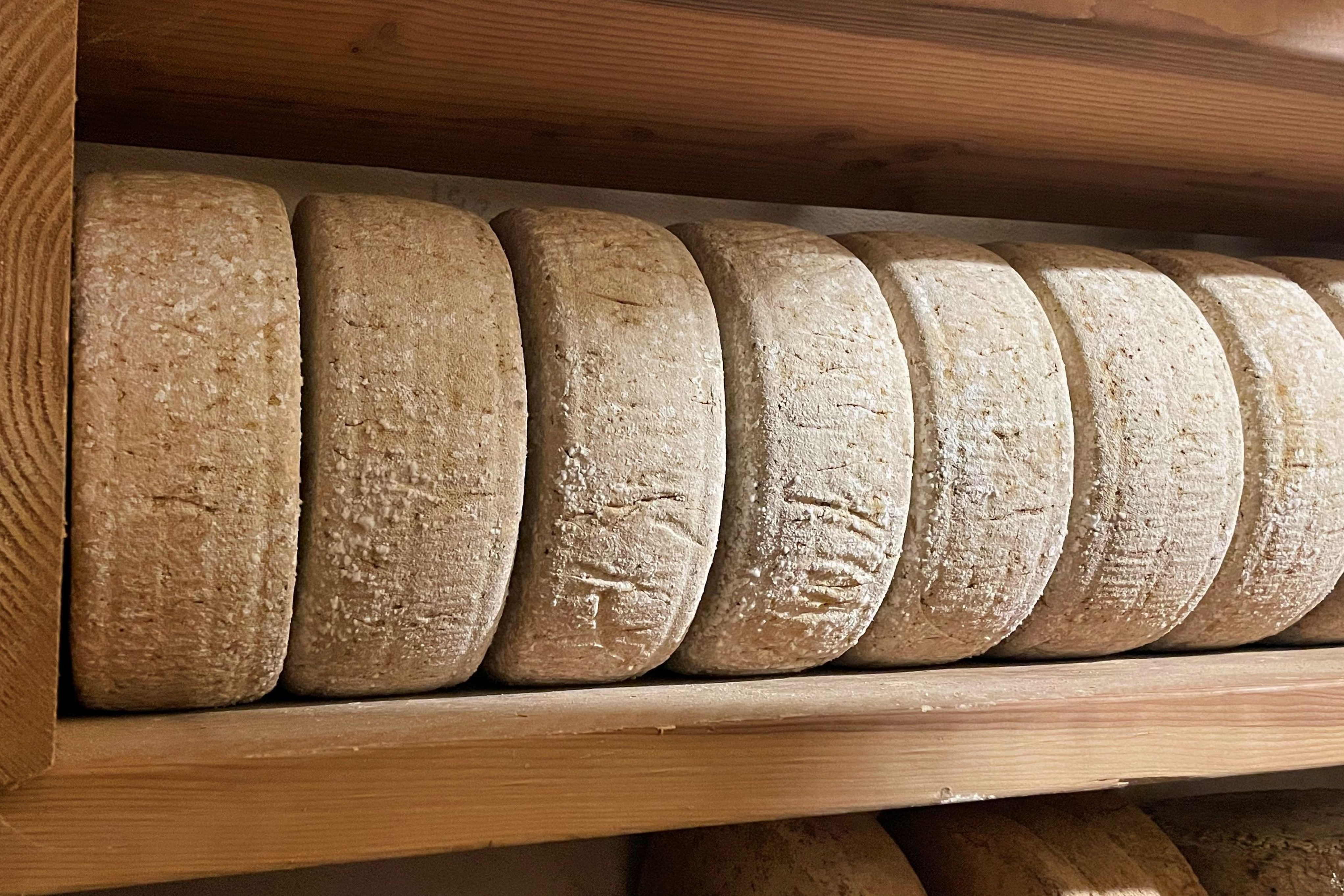
Photo provided by NE-DBIC.
As currently envisioned, the Center for Value-Added Dairy will be the go-to destination for training, technical troubleshooting, and business services for the artisanal dairy industry. It will serve makers of cheese, yogurt, ice cream, butter, and other value-added products across New England, the northeast, and the nation at large. The Center will be designed to serve people at all stages of their careers in the value-added dairy sector, from prospective new entrants to industry veterans, and from aspiring entrepreneurs to established business owners. Notably, KK&P’s concept plan accounts for the finding that value-added dairy producers are not merely looking for introductory classes and a place to perform R&D, but for an institution that offers a one-stop shop for true technical and business expertise and helps them push the boundaries of their craft and enhance their skillsets as makers.
A significant inspiration for the Center comes from a prior institution—hosted at the University of Vermont but shuttered in the early 2000s—that is credited by many for the outsized strength of Vermont’s artisanal cheese community over the past two decades. Under Laura’s stewardship, NE-DBIC has taken a broader and more long-term approach, seeing the entire northeast’s dairy sector as aligned in more ways than it is disparate and positioning a new training center as regional in its scope, in the expertise it draws on, and in the services it provides. Even its physical and organizational structure will reflect this strategy—the Center will comprise a collection of satellite locations and network of partners, rather than a single physical facility or institution.
This ambitious, big-picture perspective is in keeping with NE-DBIC’s institutional mission and collaborative approach since launching with a mandate to support and represent eleven states from Maryland to Maine. NE-DBIC has accomplished this through grants, education, technical services, and events, repeatedly directing resources and conversations towards producers and stakeholders both within and outside of Vermont. This has contributed to a collaborative, layered, multi-state movement involving not just the entire region’s producers and processors, but also nonprofits, university researchers, extension agents, technical assistance providers, and departments of commerce, labor and agriculture across the northeast.
The necessity of this regional approach is supported by an economic impact study just completed by NE-DBIC. As Laura explained, this study illustrated the “real reliance of states on each other, particularly in New England but also New York…seven states that are critically reliant on one another for production, processing, and consumption.” On the ground in Vermont, the necessity is all the more tangible, as the state lost three of its larger processing plants in the past year and no longer has a single processor of fluid milk that consolidates from multiple farms, nor a processor for organic fluid milk. The dairy business in the northeast—long since an extremely challenging one—is at a crossroads, bifurcating into large farms at one end of the spectrum and small ones at the other, and in absolute need of innovation and collaboration.
While NE-DBIC’s vision for the Center is moving towards implementation, the organization’s impact on actual cheesemakers and consumer-facing products is clear. Ginsburg cited a marketing and branding toolkit and grant program for small dairy producers, which produced a return-on-investment that was “off the charts.” Not limited to small producers, the NE-DBIC has supported efforts by Cabot and Stonyfield to change their plastic packaging to 30% post-consumer-recycled andreduce plastic weight per package overall. A more immediately visible example of remarkable packaging innovation—forehead-slapping in its obvious brilliance—comes from Moozy Milk in Connecticut, which has created a line of flavored milks in crisply branded aluminum cans (which are 100% recyclable and impact milk flavor less than paper cartons). Each of these success stories validates the tangible impact of the almost $43M in funding that NE-DBIC has awarded to 495 different projects through the end of 2025.
If NE-DBIC’s track record so far of putting completed research and recommendations into action is any indication, the value-added dairy training center is a question of when, not if. In collaboration with KK&P, Ginsberg has assembled a veritable Justice League of experts on cheese, dairy, agriculture, distribution and other domains, and that group is advancing the recommendations and implementing the plan made by KK&P, while continuing to incorporate new findings and feedback from the value-added dairy sector. Their near-term goals are to identify a host organization for the training center, secure additional funding for development and operations, and launch the first round of satellite centers.
For our part, we look forward to cracking open a can of cold Moozy’s on opening day at the New England Center for Value-Added Dairy.